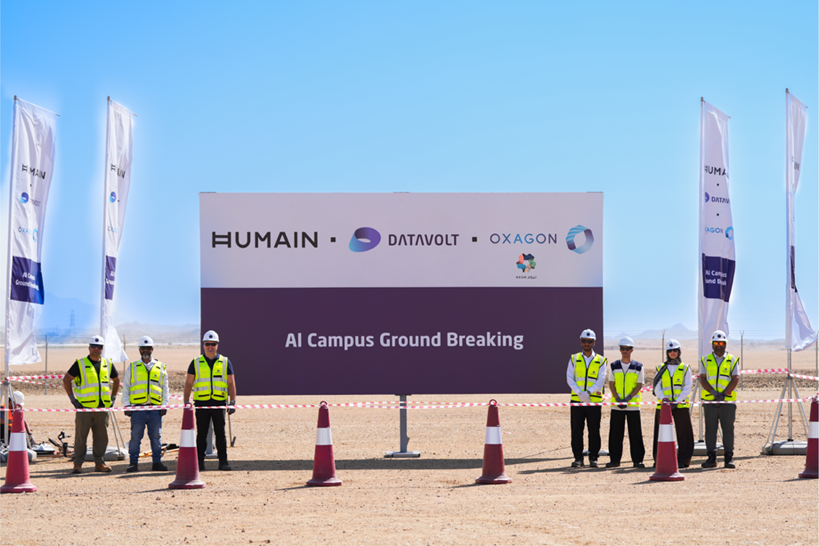
Work begins on the AI campus.
At Oxagon, the next layer of industrial development is being built around computing. On 31 August 2026, NEOM announced construction had begun on DataVolt’s AI campus, with HUMAIN participating in an initial 100 MW component expected to become available in 2028. The significance is the move from a development agreement to a construction milestone, with an identified partner and an initial operational target.
The programme has three nested scales. The HUMAIN component belongs to the 360 MW first phase, which sits within the planned 1.5 GW campus. These describe successive levels of development, not separate projects to be added together. Equally, the campus headline cannot stand in for the amount of computing infrastructure that will be ready at the first opening. Groundbreaking marks a beginning; it does not mean every future building, equipment package or phase has reached the same point.
There is another distinction behind the numbers. Megawatts express power capacity, not the number of servers or the amount of useful computation they can perform. Two facilities with a similar electrical capacity can support different hardware, software and workloads. Without a detailed technical specification, converting the announcement into a particular number of AI chips or an estimate of computing performance would give the figures a precision they do not have.
For the built environment, this makes phasing more than a matter of dividing a large site into smaller plots. The first operating area must function as a complete facility while allowing later areas to be connected. The central planning question is how much infrastructure to deliver initially, and where to leave room for expansion without committing every future stage to today’s equipment choices.
Three scales. One programme.
The initial component sits within phase one, which in turn forms part of the planned campus. The figures are not additive.
| Capacity | Scope | Status / timing |
|---|---|---|
| 100 MW | HUMAIN–DataVolt component | Construction announced; 2028 target |
| 360 MW | First phase, including the 100 MW | Groundbreaking announced |
| 1.5 GW | Wider campus | Planned |
The partnership behind the project.
The foundations of the programme predate HUMAIN’s involvement. DataVolt and NEOM signed their campus agreement in February 2025, announcing an initial $5 billion investment for phase one. Oxagon’s contribution included leased land and infrastructure support. That earlier agreement established the development framework; the expanded partnership now gives a defined portion of the campus a connection to HUMAIN’s AI activities.
The participants bring different functions to the same location. DataVolt develops and operates digital infrastructure. HUMAIN, a PIF company, works across data centres, cloud services, AI models and applications. Oxagon provides the industrial setting. Read together, these roles link the place where computing takes place with the services that depend on it, rather than treating the data centre as an isolated real-estate asset.
That connection matters because constructing a server hall and delivering an AI service are different undertakings. A building can be ready before its computing equipment, while installed hardware still needs networks, software and an operating organisation. The partnership brings those layers into the same programme, although it does not by itself reveal the allocation of every contractual responsibility. The public announcement is not a complete account of who will procure, own or operate each system.
The financial figures also belong to different scopes. The $5 billion announced in 2025 is not a newly disclosed price for HUMAIN’s 100 MW. Zawya reports that the latest announcement supplies neither a separate investment value for that component nor a delivery calendar for the other 260 MW of phase one. The first partnership therefore provides a concrete entry point into a much larger programme, while the cost and sequencing of its later parts remain less visible.
Power and cooling shape the campus.
A data centre’s visible buildings contain only part of its architectural story. Server halls depend on electrical distribution, backup power, cooling, controls and communications. The IEA describes a facility whose energy demand includes both computing equipment and the systems supporting it. Designing the enclosure independently of those systems would miss the relationships that make the building useful.
AI hardware sharpens that relationship by concentrating electrical demand and heat in the racks that house the servers. Schneider Electric describes how direct-to-chip liquid cooling removes heat at the processors while air cooling remains necessary for other components. Pumps, pipework and cooling distribution units must work together. This illustrates a wider design challenge, not a specification disclosed for Oxagon: the thermal system has to match the equipment it serves.
For architects and engineers, the consequences extend from plant spaces to everyday movement through the building. A replacement component needs a route from the delivery area to its operating position. Maintenance requires access around equipment, not simply enough space to install it once. Where future expansion is anticipated, room for additional services can be as consequential as room for another server hall. These are practical decisions about how the campus will be used over time.
Reliability also changes the meaning of efficiency. A compact arrangement may save space but become difficult to service; equipment that is accessible during construction may be obstructed after subsequent installations. The design task is to reconcile those demands before they become operational constraints. At campus scale, architecture is therefore concerned with the sequence of installation, replacement and growth as much as the form of an individual building. Oxagon’s detailed electrical and cooling arrangements have not yet been set out in the cited project announcements.
An industrial setting for digital infrastructure.
The partners present Oxagon’s industrial land, energy resources and subsea connectivity with Europe and Africa as reasons for choosing the location. These advantages concern the networks around the building as much as the site itself. A computing campus needs a place to stand, but its value also depends on being supplied with power and connected to the users and systems it serves.
This gives the project a particular place within NEOM. It is an industrial use with identifiable technical dependencies, rather than a proxy for the progress of the entire development programme. A milestone here says something about digital infrastructure at Oxagon; it does not establish the delivery status of residential districts, tourism destinations or other components elsewhere. The useful comparison is between their different functions and timetables, not a single measure of whether NEOM is advancing.
The campus also brings environmental ambition into direct contact with operational requirements. The original agreement envisaged renewable power and net-zero operation. Those are objectives for a future operating facility, not measured performance. The IEA makes an important distinction between the electricity a data centre physically consumes and the energy mix covered by its contractual arrangements. Renewable procurement and dependable electricity supply address related but different questions.
For Oxagon, the resulting design question is how the energy strategy, cooling system and pace of expansion will work together. Each new operating area adds demand, while the infrastructure supporting it has its own construction and connection timetable. A phased campus needs an energy plan that can develop alongside it. The environmental outcome will ultimately be expressed through operating performance, rather than the size of the renewable ambition in the initial announcement.
2028 is the first operational target.
The 2028 target concerns the first operating component, not completion of the entire campus. Reaching it requires several programmes to converge: the buildings, their utility connections, specialist equipment and the organisation that will run them. Progress on one does not automatically establish readiness in the others. A completed structure remains a stage in the process, rather than the final measure of delivery.
Commissioning is the bridge between installation and dependable operation. Uptime Institute describes it as a process beginning with the project’s requirements, not a brief inspection at the end. Tests establish whether equipment and systems perform together as intended, and help operating teams understand their behaviour. For a phased campus, this includes planning how later work can be tested without exposing already active computing areas to unnecessary risk.
The timetable sits within a wider industry experiencing rapid expansion. The IEA reported that global data-centre electricity demand increased by 17% in 2025, with constraints involving equipment availability, grid connections and approvals. These are sector conditions, not evidence of a delay at Oxagon. They nevertheless explain why the delivery of a transformer or an electrical connection can matter as much to an opening date as progress on the building shell.
The next operational milestone will make the project more tangible than its ultimate capacity figure alone. It will bring a defined part of the site into use and show how the partnership’s computing, building and infrastructure layers fit together. Until then, the announced construction start and the first opening target give Oxagon a clearer delivery sequence, while the larger campus remains a programme to be built out over successive stages.